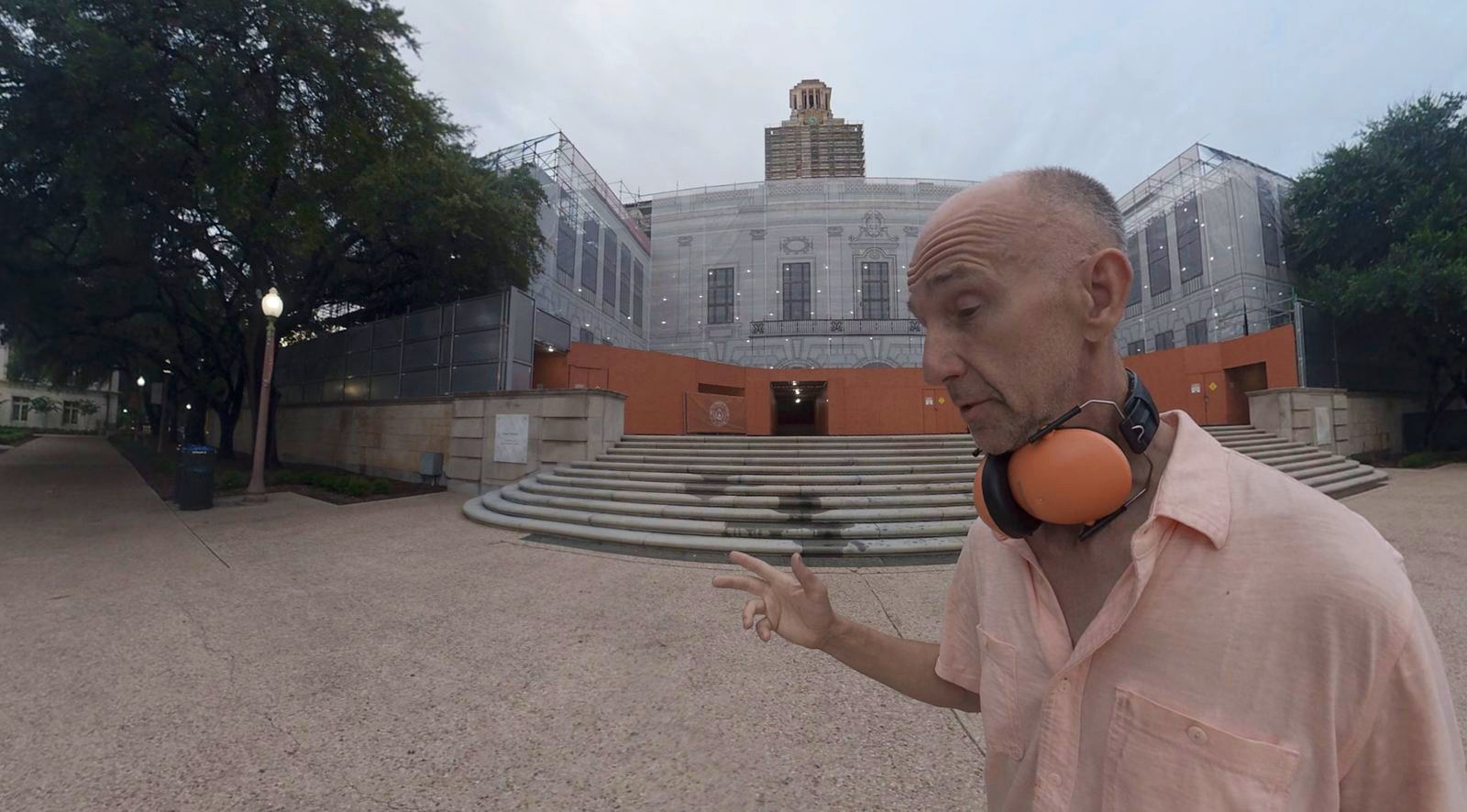
"Ye shall know the truth,
and the truth shall make you free."
— Inscribed on the University of Texas at Austin Tower
Start here — the truth I told, before what it cost
I got Lyme disease in January 2007. Around year sixteen I read The Body Keeps the Score and The Myth of Normal and finally understood something no lab had told me: part of why I wasn't healing was that no one in my family had ever really heard me. Unresolved stress, held for decades, keeps a body in a state where it cannot recover.
So at fifty-seven I did the hardest thing I have ever done. I told my father the truth — gently, in writing, with the research attached: my illness has more than one author, your part in it is real, and I can't carry the whole blame anymore so that you never have to look at your share.
That is the "why" behind every document on this site. Everything that follows — the $15,000 evaluation, the falsified scores, the diagnosis that contradicts their own report, six closed government doors — happened after I said that, and because I said it. This is not a man complaining about a bad doctor. This is what happens to someone who tells the truth to people who cannot hear one.
My father is the man who taught me to tell the truth. When I reminded him of that after Dell, he wrote back: "there are times, from my life experience, when not telling the truth is better."
And here is the same act, three times larger
A university has hidden the words "Ye shall know the truth" behind scaffolding while it hides the true intelligence scores of one of its own alumni. A senator who exposed a corrupt doctor in 2008 is now shepherding, through the Judiciary Committee, the confirmation of the President's personal criminal defense attorney to be U.S. Attorney General. That attorney has already demonstrated, in sworn testimony before that same committee, that he cannot tell the President no. The same act at three scales: hide the truth, protect the powerful, silence the one who names it.
— A UT Austin alumnus, Class of 1987 · lifelong Republican voter · 97th percentile Perceptual Reasoning, as measured by UT's own testing
What follows is the documented record. If you are a senator's staffer, a journalist, a citizen: the case is here. The six letters are here. The full evidence is here.
I am 61, in my twentieth year with Lyme disease, Bartonella, and Babesia, and I have spent the last nineteen months documenting this instead of getting treatment. If this record is useful to you, you can help me get to treatment →
I contracted Lyme disease in January 2007. Somewhere between years sixteen and seventeen of the illness, I read The Body Keeps the Score by Bessel van der Kolk and The Myth of Normal by Gabor Maté and I finally understood: the reason I was still sick wasn't just the tick. It was that no one in my family had ever really heard me — and unresolved stress, over decades, keeps a nervous system in a state where the body cannot heal.
I told my family that. Gently. With research. Because I thought if they understood, we could finally start to heal together.
Instead, they took offense — and proved my point in real time. They stopped hearing me and started managing me. Between December 6 and December 18, 2024 — during the evaluation itself — I sent emails to my sister and brother-in-law explicitly stating that I had spent my life not being heard, that I was trying to be heard now, and that this was what my healing required. They did not hear that email either. My sister contacted a family friend who serves on the Dell Medical School Advisory Board, who connected her to Dr. Charles Nemeroff's office. My parents told me: complete the psychiatric evaluation or lose financial support. I asked if we could try Stanford or UCLA instead, at a fraction of the cost through Medicare. My mother wrote back: "I'm afraid that disability check is not going to go very far."
In fairness to my family: when I recently texted my mother about the backdated Bipolar Disorder ICD-10 code (F31.9) in my lab records — the code that contradicts the final report's own statement of "no evidence of any mania" — she told me that their intention had been for me to get referrals to the Mayo Clinic through Dell. I have no doubt she believes that was the intention. But that is not what happened. What happened is documented in Dell's own signed report and in the medical records that followed. Intention does not overwrite record. The paper is what happened.
That is coercion. That is documented, in Dell's own signed report, in the Chief Complaint section:
"The patient indicated that his parents had provided him with an ultimatum of either completing the evaluation or having him cut off of financial support. He acquiesced to their request."
Under APA Ethical Standards 3.10 and 9.03, financial coercion voids informed consent. The evaluation was legally void the moment it began. They proceeded anyway. They took the $15,000.
Dr. Nemeroff's own published research documents how corticotropin-releasing factor (CRF) is elevated by chronic stress rooted in unmet emotional need, and how CRF elevation drives inflammation and disease. He proceeded, knowing the coercion, knowing his own science — inflicting on his patient the very biochemical harm his career is built on studying.
What followed:
Three conflicts of interest.
One. A family friend on Dell's advisory board arranges an evaluation of a family member. That is a conflict of interest.
Two. Dr. Charles Nemeroff, who runs the department that produced my evaluation, was exposed in 2008 by Senator Chuck Grassley's Senate Finance Committee for failing to disclose approximately $1.2 million in pharmaceutical company payments while receiving NIH grants at Emory. He had to leave Emory. He is now Chair of Psychiatry at Dell Medical School at UT Austin, and leads the Texas Child Adversity Network. That was a conflict of interest.
Three. Todd Blanche was President Trump's personal criminal defense attorney in three criminal cases in 2023 and 2024. He is now Acting U.S. Attorney General, nominated to be confirmed as U.S. Attorney General — the office with direct authority over prosecutions of his former client and his former client's family. As Acting AG, he signed the orders creating the "Anti-Weaponization Fund" and permanent audit immunity for Trump, Donald Jr., Eric, and the Trump Organization. A federal judge ruled the settlement was "obviously collusive." Thirty-five retired federal judges called it "laughable."
The amount matters, and it is worth stating precisely. The Justice Department's own announcement puts the figure at $1.776 billion — not a rounded $1.8 billion. Seventeen seventy-six. The year of the Declaration of Independence.
Reason magazine — a libertarian publication, not a left-leaning one — described the sum as "plainly arbitrary," consistent with what it called "the mysterious math that Trump has deployed in his long history of frivolous litigation." No accounting produced that number. It was chosen.
Here is how the arrangement worked, according to the public record:
On January 29, 2026, the President sued the IRS and Treasury — agencies he oversees — for $10 billion over a contractor's leak of his tax returns. Days later he told reporters: "I'm supposed to work out a settlement with myself."
The Justice Department lawyers assigned to defend the IRS never made an appearance or filing in the case. The government did not defend itself.
U.S. District Judge Kathleen Williams had begun questioning whether the case involved a genuine controversy between adverse parties at all. Before she could rule, the President's lawyers withdrew the suit — which freed the administration to settle with itself entirely outside judicial review. Judge Williams wrote that she had been "stripped of jurisdiction."
The day after the settlement was announced, the Department quietly added a provision stating that the IRS is "forever barred and precluded" from pursuing its existing tax claims against the President, his family, and his business.
The $1.776 billion comes from the federal Judgment Fund — a permanent appropriation. Congress does not vote on it. The board that decides who receives the money is appointed by Acting Attorney General Todd Blanche. The recipients may include people prosecuted in connection with January 6; asked directly why taxpayers should pay them, the President answered that it was "reimbursing people that were horribly treated."
Thirty-five retired federal judges — including Michael Luttig, a Reagan appointee — wrote that the Department's justification was "laughable given the facts of this case" and that it "only underscores the need to investigate whether the parties have perpetrated a fraud on this Court and corrupted the integrity of the judicial process."
The scale, for comparison.
Senator Grassley pursued Dr. Charles Nemeroff over approximately $1.2 million in undisclosed pharmaceutical payments. He pursued it for years. It cost Nemeroff the Emory chairmanship. He was still writing to NIH about it four years later.
This settlement moves $1,776,000,000 in taxpayer money — roughly 1,480 times that amount — out of a fund Congress never votes on, distributed by a board the President's former personal defense attorney appoints, with the IRS permanently barred from collecting existing claims against that same President.
Senator Cornyn and Senator Tillis are demanding that the Department put the termination of that fund in writing, signed by the President as plaintiff. Senator Grassley is not.
Senator Grassley, who saw conflict of interest number two in 2008, is shepherding conflict of interest number three in 2026.
Ask yourself how that can be.
Then ask: Can Todd Blanche tell Donald Trump no?
Here is the answer, on the record:
The answer is in the settlement itself.
In January 2026 the President sued the IRS and Treasury — agencies he oversees — in his personal capacity. The Justice Department lawyers assigned to defend the government never entered an appearance. Days after filing, he told reporters: "I'm supposed to work out a settlement with myself."
Federal Judge Kathleen Williams found that the parties "worked in tandem and were never actually adverse," and that the suit was "nothing more than a pretext for a 'settlement' that had no viable basis in law or fact." Before she could rule, the President's lawyers withdrew the case — which freed the administration to settle with itself entirely outside judicial review. She wrote that she had been "stripped of jurisdiction."
The settlement, signed by Blanche, created a $1.776 billion fund out of the Judgment Fund — a permanent appropriation Congress never votes on. The board that decides who receives it is appointed by Blanche. The day after the announcement, the Department quietly added language barring the IRS "forever" from pursuing existing tax claims against the President, his sons, and the Trump Organization.
Thirty-five retired federal judges — including Reagan appointee Michael Luttig — called the Department's justification "laughable given the facts of this case" and asked for an investigation into whether a fraud had been perpetrated on the court.
The man who signed all of it was the President's personal criminal defense attorney — including in the classified documents case that the same settlement resolves.
That is your answer. He does not tell his former client no. He signs what is put in front of him.
The one senator I thought would stand with me — the man whose 2008 investigation of Nemeroff is the only reason I know a U.S. Senator could hold a corrupt doctor accountable — is the same senator now pushing Blanche's confirmation.
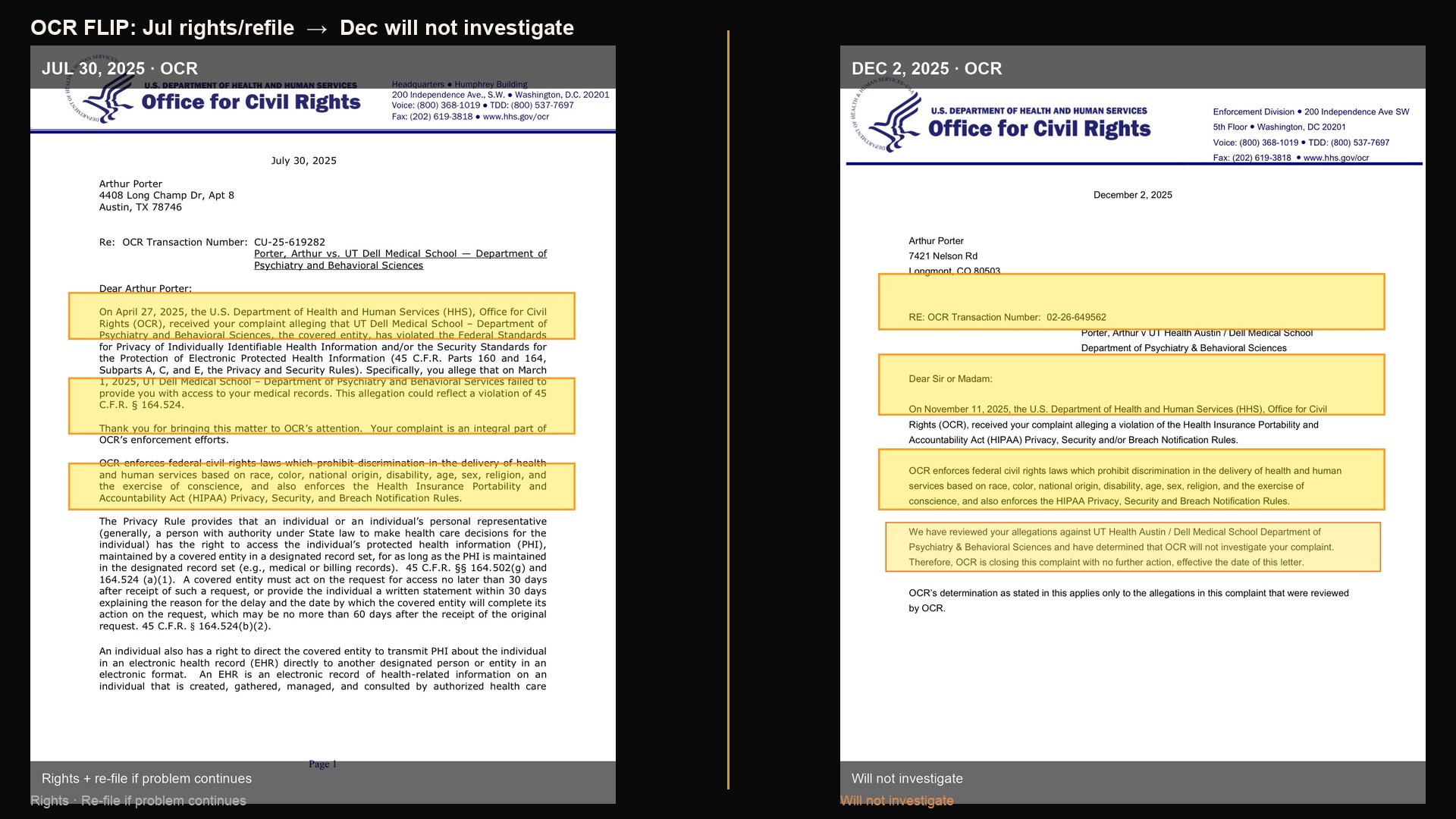
And the federal Office for Civil Rights — the agency that helped me get my records the first time — told me in December 2025, under this administration, that they will not investigate my second complaint. That second complaint was filed specifically to obtain the raw scoring data of the intelligence test the University of Texas at Austin administered to me — including the numerical values for the two scores their own report described as "exceptionally high" but declined to disclose. Those scores exist. They were generated on my brain, at my alma mater, by clinicians paid by my family. And they are being held captive from the person who earned them.
OCR's rights language — and then, on my file, the closeout:
"Your complaint is an integral part of OCR's enforcement efforts."
"We have reviewed your allegations against UT Health Austin / Dell Medical School Department of Psychiatry & Behavioral Sciences and have determined that OCR will not investigate your complaint. Therefore, OCR is closing this complaint with no further action, effective the date of this letter."
At this moment, as I write this, the University of Texas is spending an estimated $77 million scaffolding the outside of the Main Building Tower — the tower with the inscription "Ye shall know the truth, and the truth shall make you free" — to clean it, restore it, and make it shine. President Jim Davis has invoked that verse publicly. The university carved it into stone a hundred years ago.
But the verse is from John 8:32, and UT left off John 8:31. The full passage reads: "If ye continue in my word, then are ye my disciples indeed; And ye shall know the truth, and the truth shall make you free." The truth is a reward. Continuing in the word is the requirement. UT took the reward. It skipped the requirement.
And there is a warning, from the same speaker in Matthew 23:27, about institutions that polish the outside while corruption lives inside:
"Woe unto you, scribes and Pharisees, hypocrites! for ye are like unto whited sepulchres, which indeed appear beautiful outward, but are within full of dead men's bones, and of all uncleanness."
Scaffolding the outside of a tower whose inscription your own institution has stopped honoring is a whited sepulchre. Cleaning the stone while my records — the records that would let me clear my name of a diagnosis your own report contradicts — remain captive inside your walls is a whited sepulchre. Charging $15,000 for an evaluation your own signed report acknowledges was performed under financial coercion, and then hiding the scores that would prove the diagnoses were false, is a whited sepulchre.
The tower is being cleaned. The institution beneath it is not.
In his inaugural address, President Jim Davis announced the restoration. I want to quote him, because he said the thing himself and I do not think he heard it.
"We will restore the Tower... And yet, the Tower has been tarnished by time... Just as we restore public trust, revitalize our academic commitment, and reimagine our missions in research and medicine. We are going to do the same thing for that great symbol of this university."
Just as we restore public trust. He put those two things in the same sentence — restoring the limestone and restoring the trust — as though they were the same kind of work.
They are not. One is masonry. You hire a firm, you raise the scaffolding, you spend $77 million, and in a year or two the stone is bright again.
The other requires someone inside the building to say: we wrote something about a man that was not true, and we are going to correct it.
No amount of scaffolding accomplishes that. There is no contractor for it. It costs nothing and it has not been done.
And consider the phrase tarnished by time. Time did not do this. Time does not write a score of 129 into a report as "above average." Time does not enter a diagnosis code that the same report says has no evidence behind it. Time does not lose a letter whose sender confirmed sending it, and time does not close a records request without a reason.
Those were decisions. Made by people. Inside that building. And they are correctable by people, inside that building, at any moment they choose.
President Davis said he would "return it to its original glory." The original glory of that tower is a sentence carved into its face about knowing the truth. Right now that sentence is behind scaffolding, and the truth it refers to is in a file cabinet that will not open.
Restore the trust and the stone will take care of itself. Restore only the stone, and you have built exactly the thing Matthew warned about — beautiful outward, and within, something else.
I want to put one more thing beside the tower, because the shape is identical and I did not notice it until recently.
In October 2025 the East Wing of the White House — built in 1902 — was demolished to make room for a ballroom. The announced cost was $200 million, then $250 million, then $300 million, then $400 million. In June, records obtained by The Washington Post put the figure at $600 million, with roughly half coming from taxpayers — after the President had said repeatedly that private donors would cover all of it.
A federal court ruled the project required congressional approval. Construction continued while that ruling was appealed.
So set the two projects side by side.
At UT Austin: $77 million to clean the exterior of a tower, while the words carved on it go unhonored inside the building and a false record about a graduate sits uncorrected at no cost at all.
At the White House: $600 million for a ballroom, half of it public money after a promise it would be none, built through a court order saying Congress had to approve it — while the country conducts a war Congress never authorized and $1.776 billion of public money goes to compensate the President for having been investigated.
In both cases: enormous expenditure on what can be seen, and nothing at all on what would actually restore trust.
Because the second one is harder. Cleaning limestone requires money. Building a ballroom requires money. Correcting a false record requires someone to say we were wrong, and money cannot buy that at any price.
The tower will be beautiful. The ballroom will be beautiful. And a man in Texas will still have a diagnosis in his file that the institution's own report says has no evidence behind it, because no one with the authority to strike it has been willing to.
There is a detail in my own history that I did not expect to become relevant.
I was on academic probation twice at UT Austin. Both times it was because I was spending my hours with homeless people in Austin instead of in the library — and a number of them were veterans. I let one man stay in my apartment. I let a homeless woman sleep in the Jeep my parents were letting me drive, which they were not pleased to learn about later. That is what I was doing while I was supposed to be studying computer science, and it cost me academically, and I have never regretted it.
Texas is now redrawing its congressional maps mid-decade so that certain citizens' votes carry less weight.
The people at the bottom of that arrangement — the ones whose districts get redrawn around them, who have the least money, the least stability, the least ability to make noise about it — include the men I sat with on the Drag forty years ago. Some of them served this country and came home to nothing.
I could not fix their situation then. I gave them what I had, which was time I was supposed to be spending on a degree.
What is being done to me now — a record I cannot correct and no office that will hear it — is a version of what is being done to them: a person made unable to be heard, by people who will never have to face them.
I had the education, the documents, and the stamina to fight it for nineteen months, and I still have not been heard. They do not have any of that.
There is an older name for what was done to me, and it does not require anyone to share my faith to recognize it.
"Thou shalt not bear false witness against thy neighbour." — Exodus 20:16
The University of Texas at Austin, through its Dell Medical School, bore false witness against me.
They wrote in a signed medical report that a score of 129 — the 97th percentile, classified in their own testing manual as Superior — was "above average," which is not a classification in that manual at all. They entered a Bipolar Disorder ICD-10 code into my laboratory records — about a patient their own report acknowledges was there under financial coercion — while the same report stated, on page two, that there was "no evidence of any mania." I was never told the code existed. I learned of it only after the federal Office for Civil Rights compelled partial production of my own file. And they stated in writing, in November 2025, that a letter my sister confirmed in writing in April 2025 that she had sent — does not exist.
That is not a technical failure. That is a written statement about a man, by people with authority over him, that is not true.
Seven physicians signed it. Every one of them took an oath.
And the record still stands. Not one of them has corrected it. The Texas Medical Board declined to look. The University's Ethics Office did not respond. The General Counsel did not respond. The Office for Civil Rights closed my complaint with no reason given.
A false witness that no one will withdraw is not a past event. It is a present condition, and I am living inside it.
There is a contrast here that I did not go looking for.
Texas Senate Bill 10 took effect September 1, 2025. It requires the Ten Commandments to be displayed in every public school classroom in the state, in a clearly visible place, at least sixteen by twenty inches. The Fifth Circuit upheld it in April 2026. In May, the Attorney General's office opened an investigation into twenty-nine school districts, demanding they produce documentation proving compliance.
So the state of Texas has committed real institutional effort to making sure the Ninth Commandment is on the wall of every classroom.
Meanwhile, at the state's flagship university, a signed medical report bears false witness against one of its own alumni — and the state has committed no effort whatsoever to that. The Texas Medical Board declined to investigate. The University's Ethics Office did not respond. The General Counsel of the UT System did not respond. The federal Office for Civil Rights closed the complaint with no reason stated.
Twenty-nine districts investigated for whether the words are on the wall. Zero investigation of whether the words are being obeyed by a state medical school.
I am not against the display. I studied Greek for two years to read texts like that one in the original. What I would ask is simply this: if the commandment is important enough to require in every classroom in Texas, is it important enough to enforce in one clinic in Austin?
Which leads to the question I cannot stop returning to.
I am a UT Austin graduate. I can read a lab panel, build a timeline, and find the contradiction between page two and page nine of a signed report. I had the documents. I had the capacity to fight. And it still took federal intervention to obtain part of my own file, the withheld letter is still withheld, and every office that could act has declined.
If that is what happens to the patient best equipped to document it, what has happened to the others?
Dell Medical School's Comprehensive Diagnostic and Treatment Evaluation Program is a private-pay service at a public university, in which a third party can fund an evaluation of another adult. Nobody has examined how many people have been through it, or under what circumstances, or who was paying.
Nobody has looked. That program should be audited — every evaluation, every patient. Not because I say so. Because one documented case of a purchased conclusion at a public medical school is sufficient cause to check whether there were others, and no mechanism is currently doing that.
The ones who could not build a timeline are not going to raise their hands on their own.
Once you see the shape, it is everywhere in this.
At the state level: twenty-nine school districts investigated to confirm the commandment is displayed. No investigation of whether a state medical school obeyed it.
At the federal level: the President treats prosecution aimed at him as weaponization deserving $1.776 billion in public compensation, and prosecution aimed at others as justice. Same instrument, two names, depending on who is on the receiving end.
And in the Senate: a party that would demand accountability from any other administration declines to demand it from its own.
In every case the rule is applied outward and never inward. And a rule applied only outward is not a rule. It is an instrument, and calling it a principle is how you get other people to hand it to you.
These are not three separate failures. They are connected, and the connection runs directly to my file.
The office that would enforce the Ninth Commandment against UT Dell Medical School is the federal Office for Civil Rights. It closed my complaint without stating a reason. It did so under an administration that has removed seventeen inspectors general in a single night and treats internal oversight as hostile. And that administration continues because the Senate has declined to check it.
So the inaction is not passive, and it is not distant. It arrives at my address.
Senators who identify as Christians — men who would tell you without hesitation that bearing false witness is wrong — are, through inaction on their own President, sustaining the conditions under which a false witness against me stands uncorrected and unexamined.
I do not believe any of them intends that. I am certain none of them woke up meaning it. But intent is not the mechanism, and the mechanism does not require anyone's permission to keep running.
Ye shall know the truth. I am the one asking for it. UT Austin is the one keeping it.
Sit with the original number for a moment, because it gets lost in what came after.
In January 2026 the President of the United States sued the government of the United States for ten billion dollars.
Not a foreign adversary. Not a corporation. The country. And through it, the people who fund it — including me, and including every reader of this page.
The claim arose from a tax-return leak. But the settlement that emerged also resolved his grievances over the Mar-a-Lago search warrant and the investigation into Russian interference. In other words, it swept in the two occasions on which the United States attempted to determine whether he had broken the law.
Reduce it to plain English and it is this: you investigated me, you had no right, and you owe me for it.
That is not a legal theory. It is a claim of exemption. It asserts that examining him was itself the wrong — that the country's institutions were out of place in even asking, and that the citizens who fund them should pay for the offense.
He settled for $1.776 billion. Of their money. In a case where his own Justice Department never appeared to defend them.
And when two senators asked that the fund's cancellation be put in writing, he announced he would revive it if his nominee were not confirmed.
So look at what the actions themselves say.
These are the actions of someone who cannot tolerate being told he was wrong. Not disagreement — examination. The mere act of a country asking whether he broke its laws registered to him as an injury requiring compensation.
These are the actions of someone who believes the institutions of the United States exist in relation to him, rather than the other way around. Investigate him and you are not doing your job — you are committing an offense against him, and you owe him for it.
These are the actions of someone for whom no external standard applies. He did not argue the investigations reached wrong conclusions. He asserted they should not have occurred.
And these are the actions of someone who does not stop when told no. Two senators asked for one commitment in writing. His answer was to revive the fund and threaten to wait them out of office.
You do not need a clinical term for this. The conduct describes itself, and it is on the public record.
He sued the American people for ten billion dollars because they investigated him. He took $1.776 billion of their money. He had the Justice Department issue him an apology, signed by his own former defense attorney, in a case where the government never showed up to defend itself.
Whatever you want to call that, it is what he did. And a man who does that once, successfully, with no consequence, has been taught exactly one lesson about what he can do next.
Let me say this the way I'd say it at a kitchen table.
You would not hand a man the keys to a rig hauling forty tons if he fired every person who told him a tire was low. Not because he is a bad man. Because the job is not about him. It is about everybody else on the road.
The President can order missiles fired. He can point the Justice Department at whoever he wants. He can pardon anybody. He has the nuclear codes in a bag that follows him around.
You do not get any of that back once it is used. There is no do-over on a missile.
So the whole thing was built on one assumption: the man in that chair can be told he is wrong. By a judge. By Congress. By somebody in the building whose job it is to say so. And he takes it — instead of getting rid of the person who said it.
That is not one thing on a list of qualifications. That is the thing everything else hangs on. Every safeguard we have runs through a man being able to hear the word no.
Now look at the record.
He sued the country for ten billion dollars because it investigated him. He fired seventeen inspectors general in one night — those are the people whose entire job is finding wrongdoing inside the government. He fires officials who won't do what he tells them. He took the country to war without asking Congress, then described how it was going in a way his own Congressional researchers say was not accurate. And when two senators asked him for one thing in writing, he threatened them.
Every one of those is the same thing happening: somebody was in a position to tell him no, and instead of hearing it, he got rid of them.
So here is what I think, as one man from Texas who has never voted for a Democrat in his life:
A man who cannot be told he is wrong has no business holding power that cannot be taken back.
And letting it keep going — when you know this, and when the Constitution put the tool to stop it right there in the Senate's hands — is not being careful. It is not being patient. It is not waiting for a better time.
It is a choice. And whatever comes next belongs to the men who made it.
This is the most important thing on this page, and I want to say it in the plainest language I have.
A pilot flying through clouds cannot see the ground. He flies on instruments — altitude, airspeed, attitude. Those gauges are not opinions. They are information about where the plane actually is.
Now imagine a pilot who does not like what the altimeter says. So he covers it. The needle was not attacking him. It was telling him the truth. But he took it personally, and now he cannot see it.
The plane does not care. It is still exactly where it was. He just cannot see it anymore.
That is what a president's advisers are. Inspectors general, courts, Congress, intelligence briefings, the press — those are the instruments. They tell a man where the country actually is, as opposed to where he would prefer it to be.
When you punish the people who bring bad news, the bad news does not get fixed. It just stops arriving.
Fire an inspector general and the corruption does not go away. You only stop hearing about it. Fire the official who says an order is unlawful and the order does not become lawful. You only stop being told. And every single person still in that building learns the lesson in one afternoon: telling this man the truth ends your career.
So they stop telling him.
And now a man is flying the country on instruments he covered up himself — while holding the power to launch missiles, direct prosecutions, and start wars. None of which can be taken back once done.
I am not asking anyone to decide whether he is a good man. I do not know him.
I am saying something narrower and much harder to argue with: when a man processes disagreement as a personal attack rather than as information, the feedback loop stops working. And a president without a working feedback loop is not a president with a flaw. He is a control system with the sensors disconnected.
It does not matter how strong he is. It does not matter how much he loves the country. A pilot who covers the altimeter out of pure patriotism still flies into the mountain, and everybody on board goes with him.
My family did the same thing to me, at a scale of one person.
I brought them information: this plan is not working, and here is a cheaper alternative I have researched. That is a reading off a gauge. It was not an insult and I did not intend it as one.
They did not check the reading. They did not argue with it. They treated it as an attack, and then they spent $15,000 on a document declaring that the instrument itself was defective.
The reading never stopped being accurate. I really was not getting well. They simply arranged never to have to look at it again.
Four more years went by. It cost them more than the trip would have. It cost me my health.
That is the small version of what is happening to this country right now. Same mechanism, same refusal, different scale — and the scale is missiles and treaties and a strait that has been closed for five months.
There is a second half to this and it is worse than the first.
Disconnecting an instrument leaves you blind. But installing an instrument that only shows the reading you want leaves you confident — and confidently wrong is how planes come down.
Look at who has been removed and who has been installed.
General CQ Brown, Chairman of the Joint Chiefs of Staff — a career combat pilot — was fired. Pete Hegseth, a weekend host on Fox News, had publicly said the chairman needed to be fired. Hegseth is now Secretary of Defense.
Seventeen inspectors general removed in a single night. Career Justice Department officials fired for declining unlawful instructions. And the nominee for Attorney General is the President's own former criminal defense attorney — the man who represented him in the classified documents case, now proposed to run the department that would investigate him.
Any one of those could be argued about on its own. Together they are not a series of personnel decisions. They are a filter.
The organization Demand Justice reviewed fifty-seven of this President's judicial nominees — people seeking lifetime appointments to the federal bench — and asked each of them a version of the same question: did Joe Biden win the 2020 election?
Not one of them would say yes.
All but one used the identical formulation: that Biden was "certified" as the winner. Thirty of them said Biden "served" as president. Not a single one said he "was" president. Forty-seven of fifty-seven gave nearly identical answers about January 6, most calling it a "political issue" they would not discuss further.
In July 2026 the nominee for Director of National Intelligence was asked the same question repeatedly in his confirmation hearing. He would say only that Biden was "certified." Pressed further, he said: "I'm not going to do this with you."
Fifty-seven people, independently, arriving at the same careful phrasing. That is not coincidence and it is not a legal scruple. Everyone in that room understood what would happen to a nomination if the nominee said four ordinary words out loud.
These are not people being asked to endorse a policy. They are being asked to confirm a fact — one certified by all fifty states, upheld by more than sixty courts, and affirmed by the Congress that both parties sat in.
And the price of the job is that you cannot say it.
So consider what has been built. Judges appointed for life, an intelligence director, a defense secretary, an attorney general — all selected through a filter whose single reliable test is whether you will decline to state a plain fact when it displeases one man.
Those are the instruments now. Every one of them was chosen for its willingness to read what he wants.
A pilot who covers the altimeter is flying blind. A pilot who installs a new altimeter guaranteed to show whatever altitude he prefers is flying blind and does not know it — and neither does anyone else aboard, because the panel looks fine.
That is the United States government right now. And a man who selects for that is not looking after the country. He is assembling a set of readings that agree with him, and there is only one person that arrangement is built to serve.
He calls them "Dumocrats" in his own posts.
Set aside whether that is beneath the office. Notice what it tells you mechanically. A man who can hold the possibility that people who disagree with him might be partly right does not need to rename them. Renaming is what you do when disagreement registers as an attack instead of as input.
You cannot take a reading from an instrument you have decided is your enemy.
Senators — you are one of the last instruments still connected.
He cannot fire you. That is the entire reason the Framers made the Senate independent. They knew that eventually a man would sit in that chair who could not stand to be told he was wrong, and they made certain there would be one gauge he could not cover.
You are that gauge. Right now you are reading, and not saying what you see.
We are already in dire straits. We stay there as long as the man flying refuses to look at the panel, and the people who can still see it say nothing.
I want to say something directly to the person reading this who is having the thought I would be having.
A family paid a medical school to produce a document about their own son. The school wrote a 97th-percentile score down as something lesser and entered a diagnosis its own report says had no evidence behind it. Six agencies declined to look. And the man it happened to says the same pattern is running at the top of the federal government.
That is a lot. If your first reaction is that this cannot all be true, that is the right instinct and I would rather you have it than not. I have had it about my own life. There were months where I assumed I must be misreading my own documents, because the alternative was that seven physicians signed something untrue and no one would correct it.
I have also run this material past several AI systems while building this record. More than one of them treated my claims skeptically at first — the way you would treat a stranger's conspiracy theory — and then searched, and found the source, and changed its answer. One of them told me my claim about a settlement provision was wrong and warned me it would damage my credibility. It was not wrong. The reporting confirmed it.
I mention that because it taught me something useful about how this works.
Implausibility is protective. The more extreme the conduct, the more reliably the first response is that can't be right — and that response is exactly where such conduct survives. A President suing an agency he controls, his own Justice Department declining to defend, the judge stripped of jurisdiction before she can rule, and a figure of $1.776 billion that appears to have been chosen because it sounds like a year: a screenwriter would cut that as too obvious. It is happening anyway, and it is on the public record.
So I have not asked you to believe me anywhere on this site. Every claim here carries its source, because you should not have to decide whether I am credible. You should be able to check.
Not one of these requires taking my word for anything. That is deliberate.
I spent two years at seminary learning Greek because I wanted to read a text without a translator standing between me and it. I am asking you to do the same thing here.
I am a UT Austin alumnus, Class of 1987. I am 61 years old. I have Lyme disease, Bartonella, Babesia, and documented mold toxicity. And I am a whistleblower.
I have sent six letters. The first three are to the Republican senators who can stop this nomination if they hold the line — Cornyn (my own senator in Texas), Tillis (his ally on the paper-controls principle), and Thune (the Senate Majority Leader who controls the floor calendar). The fourth is to Chairman Grassley — the whistleblower's champion — asking him a single question. The fifth is to the General Counsel of the University of Texas System.
I am asking the American people, and the people of Texas, to watch what happens next.
If a senator can see the first two conflicts of interest and cannot see the third, that is not blindness. That is choice.
If a general counsel who took an oath at West Point can be notified of documented institutional misconduct and do nothing, that is not oversight. That is complicity.
If the Attorney General of the United States cannot tell the President no, then he is not the Attorney General. He is the President's attorney.
I am one man with a documented case. But my documented case is a map of what is being done at every scale, right now, to this country.
I am in my 20th year with Lyme disease. Before that, I graduated from The University of Texas at Austin with a B.A. in Computer Science, 1987 — where I was on academic probation twice because I was spending my time helping homeless people in Austin, including veterans, instead of studying computer science. After UT, I went to Dallas Theological Seminary for two semesters, studying Greek, because I wanted to read the Bible in the language it was written in and know what it actually said. What I learned there was that even the Greek professors had to choose between two possible translations of a single word, and their preconceptions shaped the choice. That is when I understood that the objective truth I had been seeking would not be found by more study — it would only be found by more honesty.
In 1999, while at seminary, I fasted for 41 days on juice — praying for this country. In 2005 I walked away from a software career to lead a work crew of at-risk young men in inner-city Dallas. I have never had more than $19,000 in the bank in my life, until I received disability back-pay. I have sacrificed a career, a family, and eventually my health to try to live inside the truth I was taught mattered.
The last President I had the energy to research thoroughly and vote for was a Texan — George W. Bush. I have never voted for a Democrat. Anyone who tries to dismiss what I am about to say as coming from a partisan is lying to themselves about who is speaking.
I am a UT Austin alumnus, a former seminarian, a disabled American, a lifelong Republican voter, and — as measured by The University of Texas at Austin's own psychological testing in December 2024 — I have Perceptual Reasoning at the 97th percentile.
If you want to tell me the Ten Commandments belong on the classroom wall, show me your walk before you point at your talk. Show me the years you spent among the homeless — the veterans I helped, the homeless girl I let sleep in my Jeep Wagoneer, the other I let stay in my apartment while I was on academic probation twice at UT for spending my time on them instead of on my degree. Show me the software career you walked away from in 2005 to lead a work crew of at-risk young men in inner-city Dallas. Show me the seminary transcripts. Show me the 41-day fast. Show me the disease you kept fighting through. Show me the bank account that never held more than $19,000 because you kept giving it away. And then, when you have shown me all of that, explain to me how the Ninth Commandment — thou shalt not bear false witness against thy neighbour — does not apply to what The University of Texas at Austin has done to me, its own alumnus, in writing, on file, for fifteen months and counting.
If you cannot explain that, then you do not get to call me a liberal.
You get to answer the question.
Read the letters.
To Cornyn To Tillis To Thune To Grassley To KennedyThe full documentation: here
I am still on disability with Lyme disease, Bartonella, and Babesia. If this record has helped you understand what happened, you can support the work →
I am still on disability with Lyme disease, Bartonella, and Babesia, fighting this case while unable to begin the medical treatment I need. If this record has been useful to you, you can help →
The primary sources
Everything above rests on documents. They are all in the companion archive: eight chapters of the case, the 467-email chronology in date order, the exhibits, and the media.