I told my father the truth. That is what set all of this in motion.
Around year sixteen of being sick, I read The Body Keeps the Score and The Myth of Normal and understood something no lab test had told me: stress you can't resolve, carried for decades, holds a body in a state where it cannot heal.
So at fifty-seven I said it out loud, in writing, with the research attached — my illness has more than one author, your part in it is real, and I can't keep carrying the whole blame so you never have to look at your share.
Everything below happened after I said that, and because I said it. This isn't a man complaining about a bad doctor. It's what happens to someone who tells the truth to people who cannot hear one. The evaluation that follows was not medicine. It was an instrument — and the paperwork it produced says more about the people who signed it than about the man it names.
1 · What it costThey called it a comprehensive medical evaluation. It was nothing of the kind.
One thing before the details, because words leave impressions: nothing in this story is a finding about my mind. Their own testing measured a 97th-percentile mind, their own intake notes voided the evaluation before it began, and their own report contradicts its own codes. A report like that reflects on its authors. Read on and judge for yourself.
And for the record of who this happened to: in college I served the homeless. In the years after, I led youth groups. At forty, I mentored at-risk young men. A life spent on the serving side of the table is the one this report was written about.
I was told it would be one thing — a full medical workup. What I got was an evaluation of my mind instead of my body. My Lyme labs were ignored. Nearly everything I told the doctors was ignored. I told the truth, and it was not heard — because what was heard was the $15,000 that paid for the evaluation, arranged through a family friend on Dell Medical School's own advisory board. That is a conflict of interest. Two conflicts of interest.
The same kind of conflict of interest Senator Chuck Grassley investigated in 2008 and 2012. The same doctor he investigated — Dr. Charles Nemeroff — chaired the department that evaluated me, and still works in Texas today as Director of the Institute for Early Life Adversity Research. And the same senator who exposed Dr. Nemeroff's conflicts — roughly $1.2 million in undisclosed payments from drug companies while at Emory University — is, this very morning, approving a conflict of interest at the highest level of our national government.
2 · Their own report says soThe coercion is in their paperwork — page one.
“The patient indicated that his parents had provided him with an ultimatum of either completing the evaluation or having him cut off of financial support. He acquiesced to their request.”
— Dell Medical School, signed final report, Chief Complaint section
Under the American Psychological Association's own rules, coercion voids consent. The evaluation was invalid before it began. They ran it anyway — and billed my family.
3 · Then the numbers moved — all in one directionA “Superior” score, written down as ordinary.
What the test manual says
129 = “Superior”
97th percentile — top 3%
What they wrote in the report
“Above average”
a category the manual doesn't contain
Two more scores their own report calls “exceptionally high” had the numbers left off the page entirely. Every single discrepancy moved the same way: down. Honest errors scatter. A thumb on the scale never does.
4 · A diagnosis their own report denies“No evidence of any mania.” Then a code for a condition I don’t have showed up in my file.
Years ago — the condition runs in the family through an aunt — I had it tested. The test was negative, and I told my sister so. Three weeks before the evaluation she wrote instructing me to report “periods of mania or psychosis” to the doctors. The report says it plainly on page 2 — no mania. Yet my file carries a code for that condition, never disclosed to me. I found it only after a federal agency forced them to hand over my own records. UT then began mailing me invitations to a research study for it. I'm on Medicare — that's public money moving on a label their own document says has nothing behind it.
5 · Who runs that departmentThe chairman is a doctor Senator Grassley investigated — twice.
Dr. Charles Nemeroff — exposed in 2008 over $1.2 million in undisclosed drug-company payments, pursued again in 2012. His life's research: how unresolved stress inflames the body and makes people sick. Which is exactly what an uncorrectable false record has done to mine, every day since.
6 · I asked everyone. Every door closed.Six offices. One apology — from the person with the least power in the story.
Only my mother has said sorry. Not one institution has.
July · first OCR letter
“Your complaint is an integral part of our enforcement efforts.”
December · second OCR letter
Closed. No reason given.
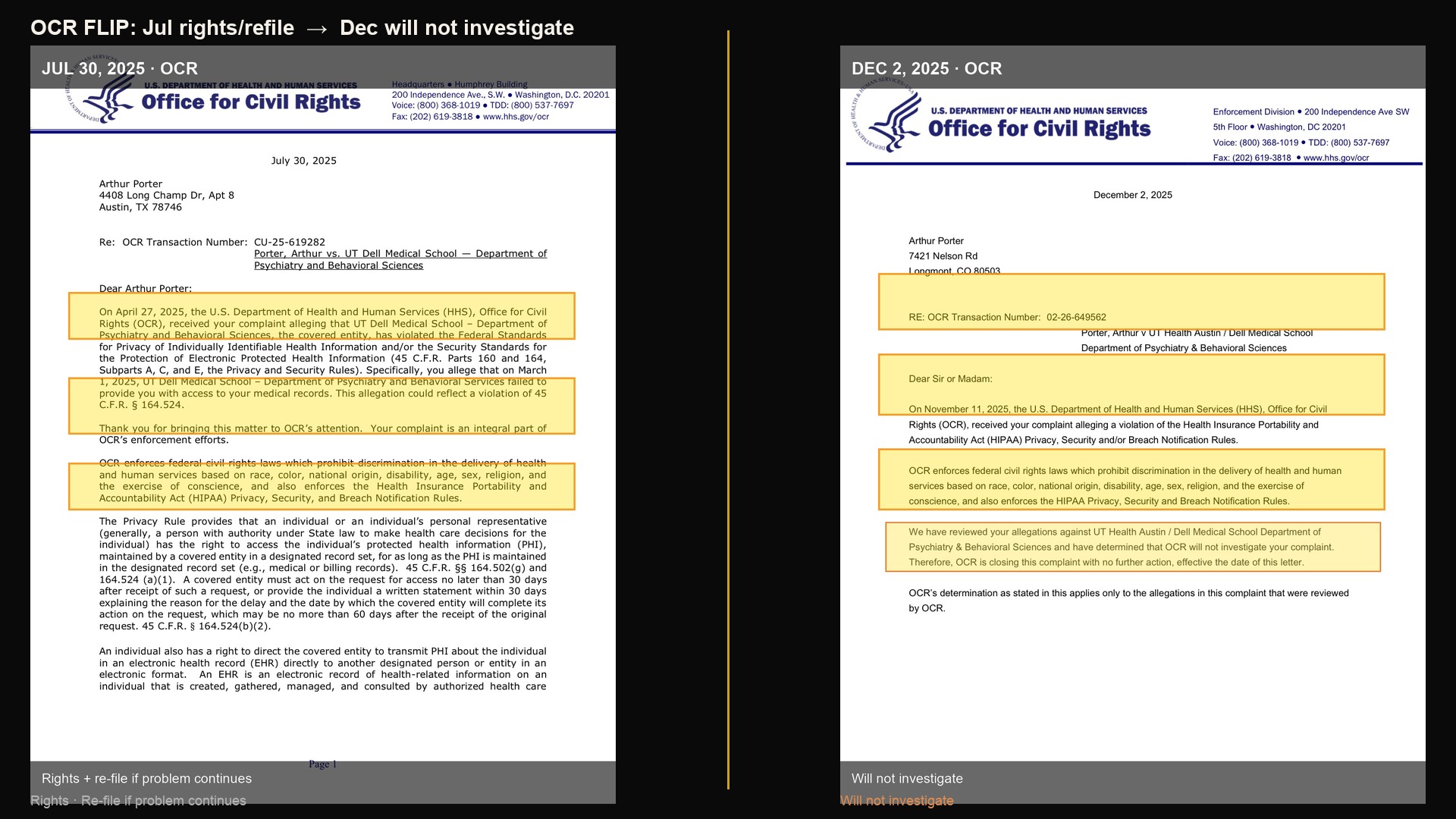 7 · Why this reaches Washington
The last door was federal — and federal oversight has been dismantled.
Seventeen inspectors general were fired in a single night — more than every previous president combined. Their whole job is finding wrongdoing inside an agency. Removing them doesn't stop corruption; it stops corruption from being found. The office that would have heard me still exists. It simply doesn't investigate anymore.
A small case in Texas sits closed because a large one in Washington is unresolved. That isn't a metaphor. It's the mechanism.
8 · The question I can't stop askingThis happened to me with a 97th-percentile brain and every document saved. How many people can't fight back?
I had the reasoning to catch it, the records to prove it, nineteen months to fight it — and a federal agency was still required just to show me my own file. That program lets any third party pay for an evaluation of another adult. Access came through a family friend who attends our church and sits on the medical school's behavioral health advisory board — a door most people don't have. And the office meant to investigate this kind of thing has stopped investigating.
The people without the documents, the stamina, or the test scores are not going to raise their hands. That is exactly why I'm raising mine.
9 · The pattern, in three stepsMy father. My university. My government.
My father taught me truth-telling is non-negotiable — then, when I used it on him, wrote to me: “there are times when not telling the truth is better.”
Dell Medical was told in writing that I was there under coercion and had active infections. They finished the paperwork instead.
The President fires, sues, or disbands anyone who holds him to account — inspectors general, prosecutors, generals — and the Senate, which holds the one remedy the Framers built for exactly this, has not used it.
It's the same act at every scale: someone tells the truth, and the powerful person answers by discrediting the one who said it.